





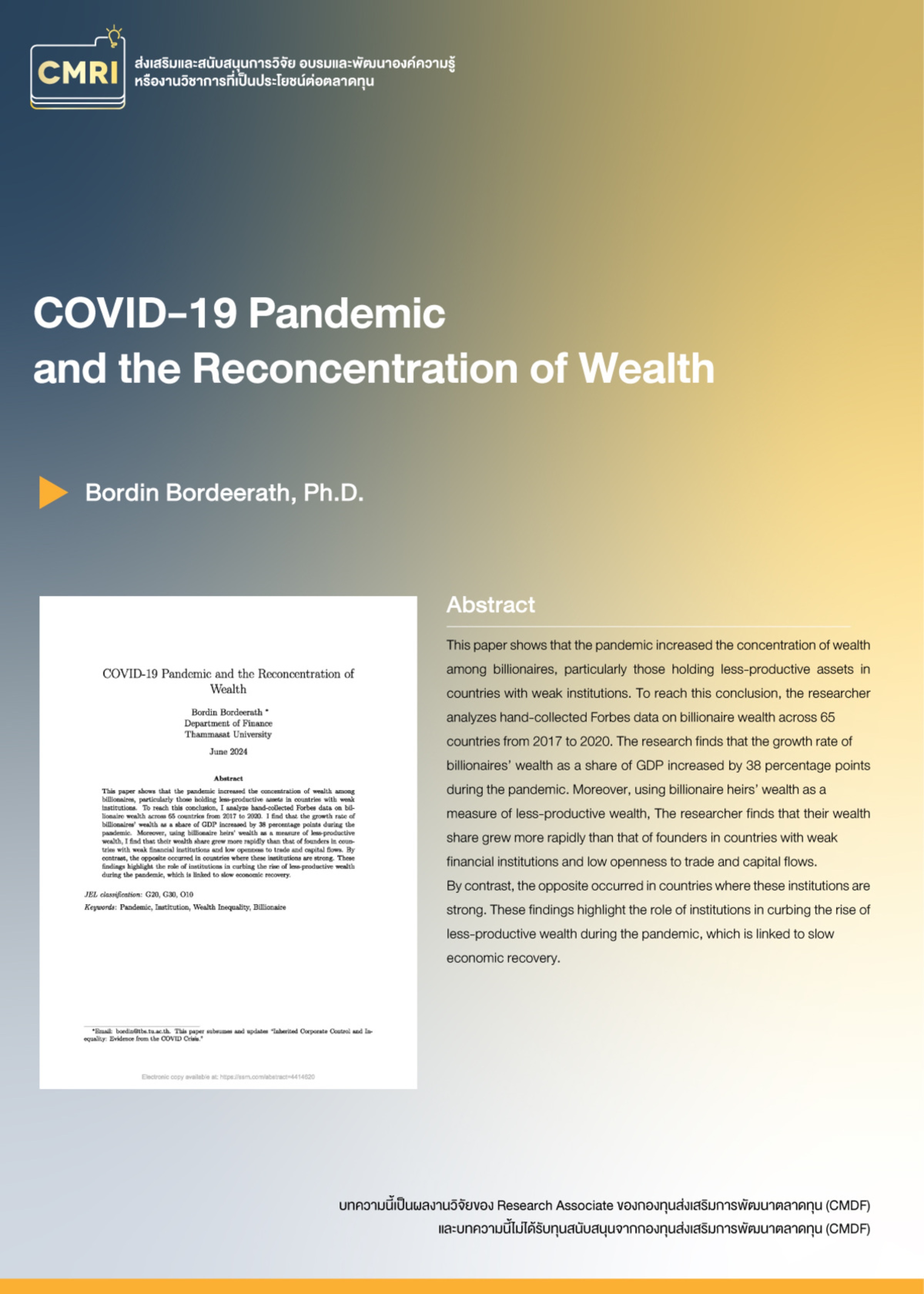
The research paper examines how the COVID-19 crisis affected billionaire wealth concentration worldwide. It distinguishes between wealth created by business founders and wealth inherited by heirs to assess whether institutional conditions influence the sources and economic consequences of wealth accumulation.
The researcher manually compiled Forbes data covering billionaires in 65 countries from 2017 to 2020, analyzed changes in billionaire wealth relative to GDP and compared countries according to the strength of their financial institutions and their openness to international trade and capital flows.
The findings show that the growth of billionaire wealth relative to GDP increased by approximately 38 percentage points during the pandemic. In countries with weaker financial institutions and lower economic openness, the wealth of billionaire heirs grew faster than that of business founders. The opposite pattern was observed in countries with stronger institutions. Growth in inherited billionaire wealth was also associated with slower economic recovery.
The study recommends strengthening financial institutions to channel capital toward productive firms and new entrepreneurs, promoting trade and capital openness to support competition, reducing monopolistic practices and rent-seeking, and ensuring that crisis-support measures are transparent and do not disproportionately benefit established business groups.
อ่านงานวิจัยได้ที่:
https://www.sciencedirect.com/science/article/abs/pii/S093936252500038X?via%3Dihub
DOI: 10.1016/j.ecosys.2025.101326
หมายเหตุ: บทความนี้เป็นผลงานวิจัยของ Research Associate ของกองทุนส่งเสริมการพัฒนาตลาดทุน (CMDF) และบทความนี้ไม่ได้รับทุนสนับสนุนจากกองทุนส่งเสริมการพัฒนาตลาดทุน (CMDF)