





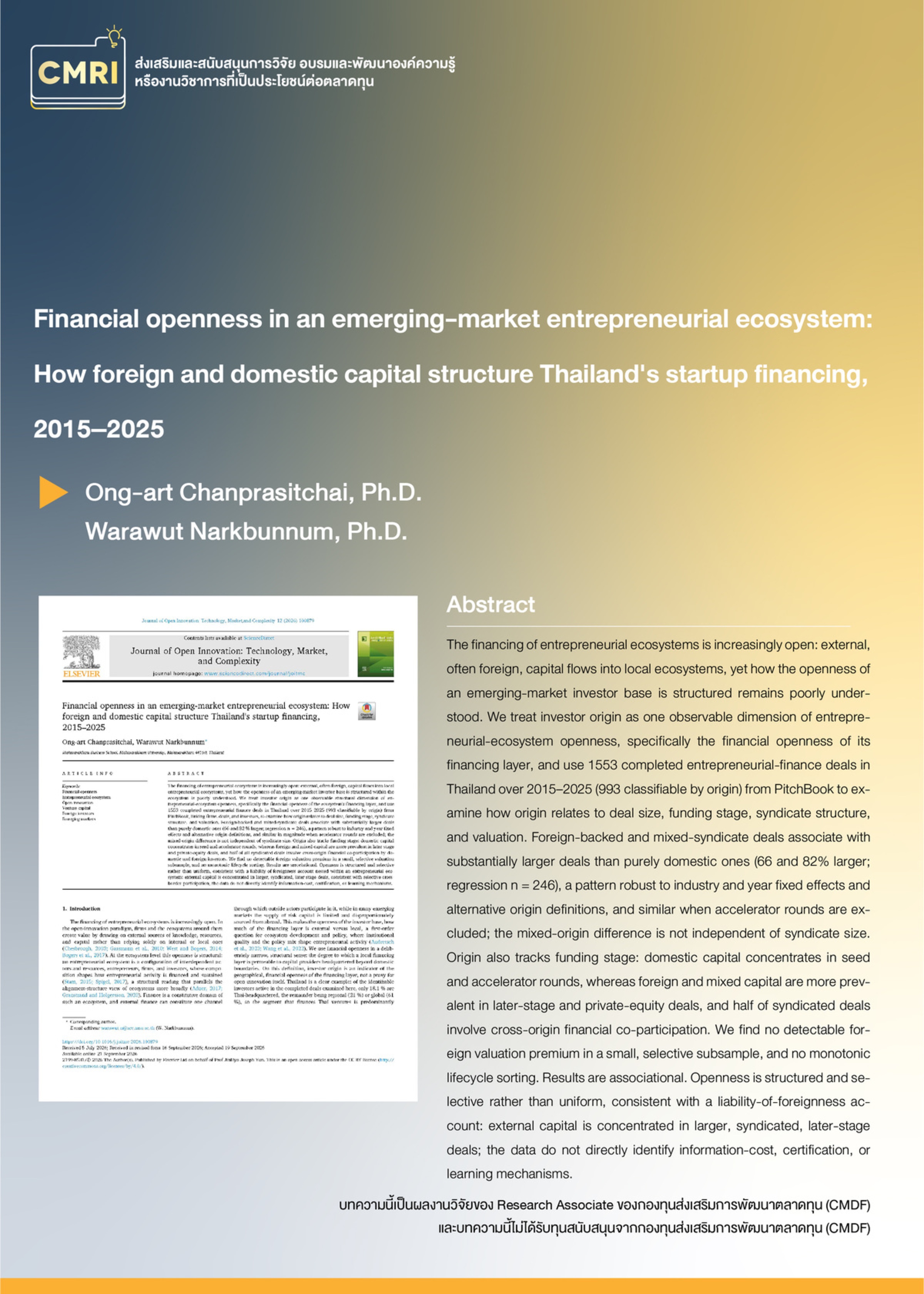
This study examines how domestic and foreign investors participate in Thailand’s startup financing ecosystem across funding stages, deal sizes, syndicate structures, and venture valuations. It treats investor headquarters location as an observable indicator of the financial openness of the ecosystem’s financing layer, rather than a direct measure of open innovation or knowledge transfer. Using PitchBook data on 1,553 completed entrepreneurial-finance deals between 2015 and 2025, including 993 classifiable by investor origin, the study characterizes how domestic and international capital are distributed across the observed financing market.
The findings show that financial openness is structured and selective. Domestic financing is concentrated in seed and accelerator rounds, while foreign and mixed-origin capital are more prominent in larger deals and in parts of the later-stage and private-equity market. Among identifiable investors, 18.1% are headquartered in Thailand, although domestic investors participate in approximately 52% of origin-classified deals. In the complete-case deal-size regression sample of 246 deals, foreign-only and mixed domestic–foreign deals are associated with funding amounts approximately 66% and 82% larger, respectively, than purely domestic deals, controlling for firm revenue, firm age, industry, and year.
Cross-border co-investment is a substantial feature of syndicated financing. However, mixed-origin participation is no longer independently associated with larger deal size after controlling for syndicate size, indicating that the initial difference should not be interpreted as a distinct benefit of mixing domestic and foreign investors. Despite the overall association between investor origin and funding stage, the analysis does not support a monotonic increase in foreign investor share across the funding lifecycle. It also detects no statistically significant association between foreign investor share and post-money valuation in a small, selective sample of 75 deals; this does not establish the absence of a valuation premium.
Overall, the study provides evidence on the selective structure of international capital participation in an emerging-market entrepreneurial ecosystem. Its findings are associational and apply to observed completed deals, rather than all startups or unmet financing needs. Strengthening domestic investment capacity, supporting cross-border syndication, and evaluating instruments for later-stage financing emerge as policy considerations, although their effectiveness is not tested. The study’s contribution lies in documenting the structure of financial openness while leaving its causal effects and knowledge-transfer mechanisms for future research.
อ่านงานวิจัยได้ที่:
https://www.sciencedirect.com/science/article/pii/S2199853126001654?via%3Dihub
DOI: 10.1016/j.joitmc.2026.100879
หมายเหตุ: บทความนี้เป็นผลงานวิจัยของ Research Associate ของกองทุนส่งเสริมการพัฒนาตลาดทุน (CMDF) และบทความนี้ไม่ได้รับทุนสนับสนุนจากกองทุนส่งเสริมการพัฒนาตลาดทุน (CMDF)