





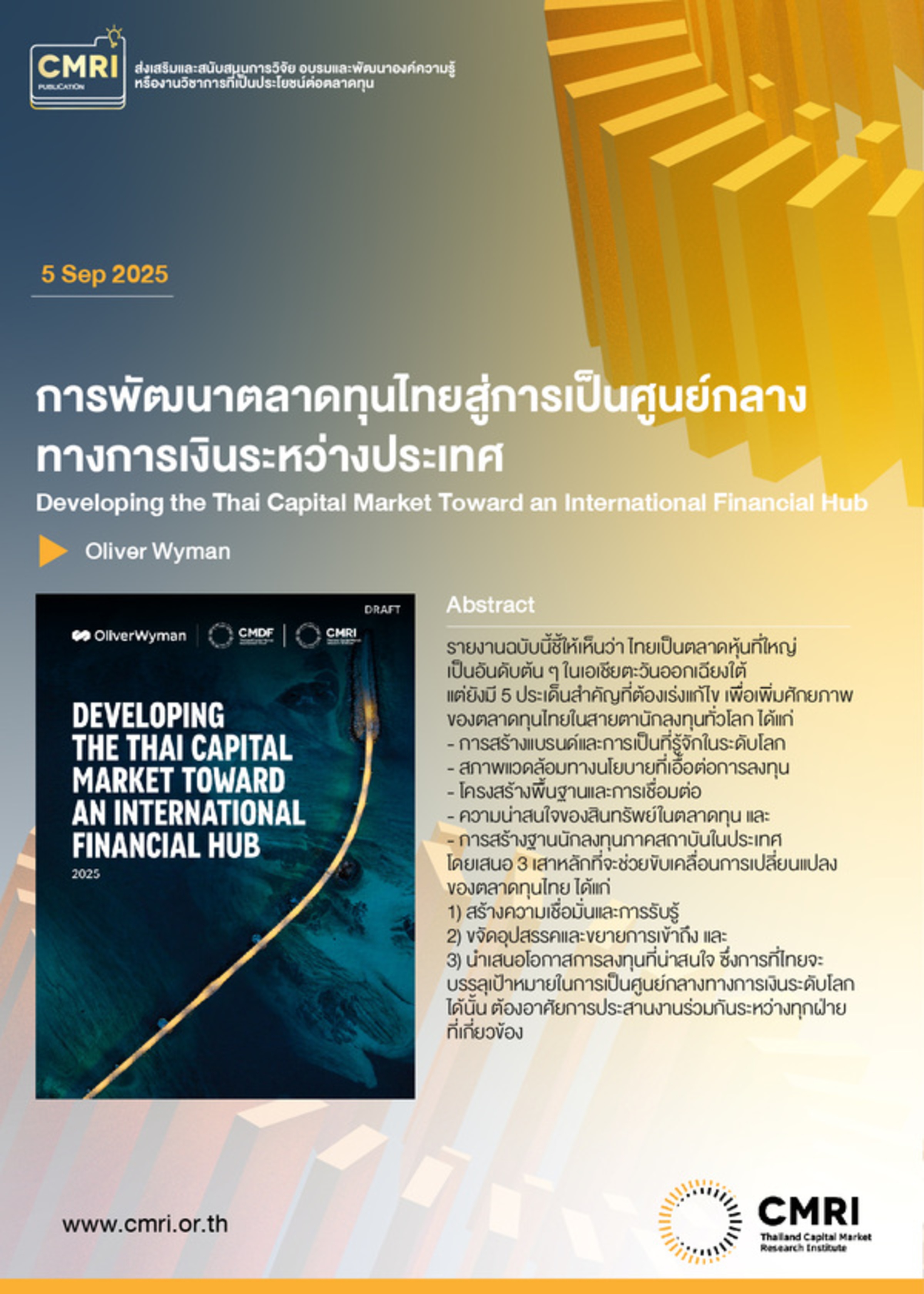

Abstract
This report highlights that Thailand is one of the largest stock markets in Southeast Asia, as measured by market capitalization and initial public offering (IPO) volume, further supported by a robust bond market. However, five key issues must be urgently addressed to enhance the Thai capital market's appeal to global investors: global branding and visibility, an investment-friendly policy environment, infrastructure and connectivity, the attractiveness of capital market assets, and the development of a domestic institutional investor base.
Three key pillars will drive the transformation of the Thai capital market:
- Rebuild confidence and visibility: Elevate Thailand's international image through targeted promotion, improve credit ratings and index coverage, and strengthen anti-money laundering measures in special financial zones.
- Remove frictions and expand access: Address capital flow constraints by building a broader and more efficient ecosystem — for example, developing a future-ready workforce, creating an investment-friendly regulatory environment, diversifying product offerings, improving connectivity with other markets, enhancing frameworks for issuers, upgrading financial infrastructure and intermediary operations, and expanding the domestic institutional investor base, among others.
- Offer attractive investment opportunities: Focus on high-potential sectors such as offshore wealth management, digital assets, and sustainable finance to attract new capital inflows.
Ultimately, for Thailand to achieve its goal of becoming a global financial hub, coordinated efforts are required among market operators, intermediaries, issuers, and investors, underpinned by a predictable framework aligned with international standards and supported by modern infrastructure. Progress should also follow a roadmap with clear targets, transparent monitoring, and sufficient flexibility to adapt to evolving global conditions.