





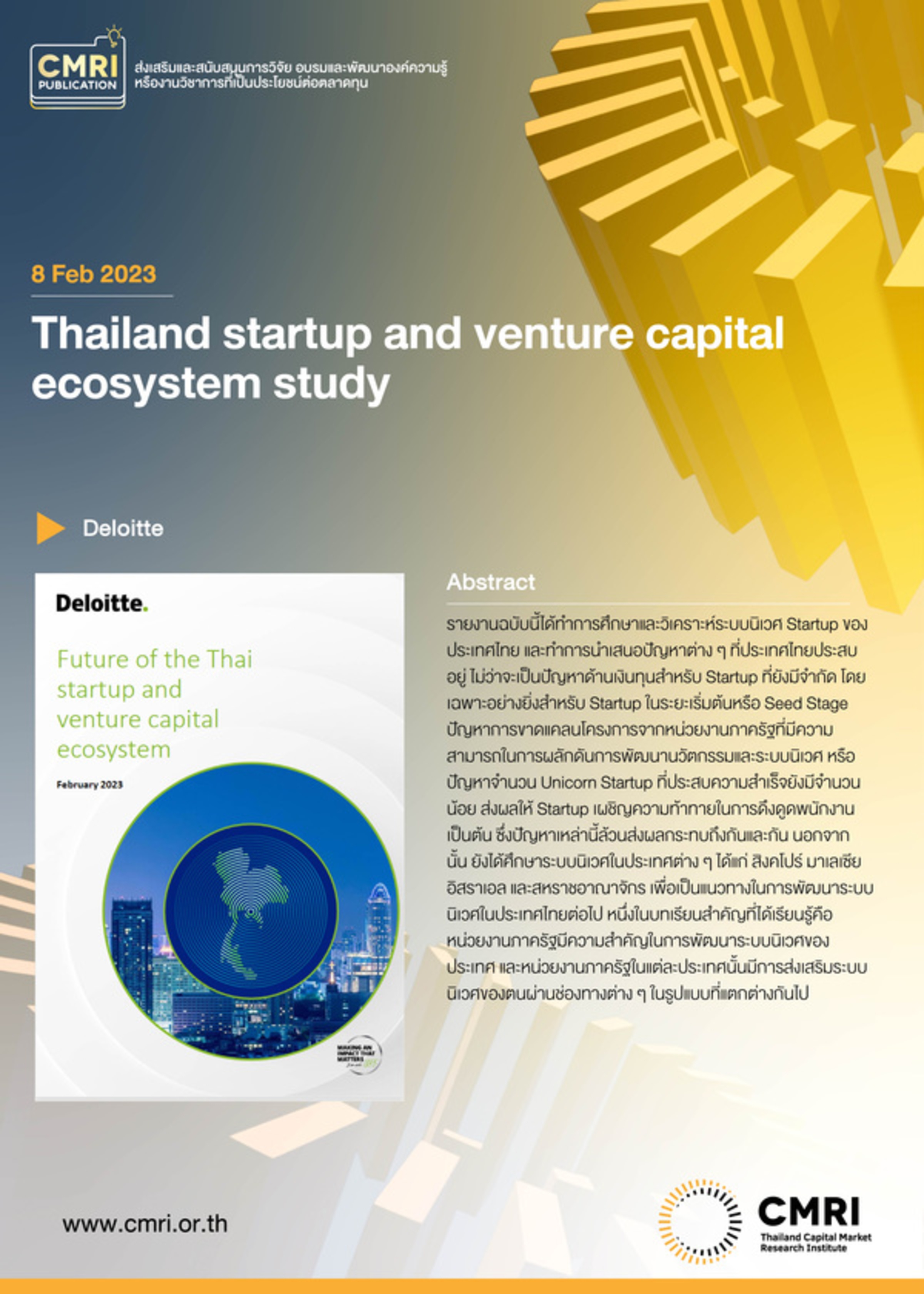

Abstract
This report studies and analyzes Thailand's startup ecosystem and presents the various challenges the country faces — including limited funding for startups, particularly at the Seed Stage; a shortage of government programs capable of driving innovation and ecosystem development; and the small number of successful Unicorn startups, which makes it difficult for startups to attract talent. These problems are all interconnected.
The report also examines startup ecosystems in other countries — Singapore, Malaysia, Israel, and the United Kingdom — to draw lessons for developing Thailand's ecosystem. One key takeaway is that government agencies play a critical role in ecosystem development, and each country's government promotes its ecosystem through different channels and in different ways.
The study finds that in developed ecosystems, government agencies typically have a clear vision and approach for developing their ecosystems, and often establish national Cornerstone Programs to drive ecosystem development, such as public-private co-investment programs.
Research Bite: Where Are Thai Startups Stuck?
Although startups are seen as a key engine of economic growth and innovation, in reality many Thai startups face obstacles from inception through later-stage growth — whether constraints in funding, infrastructure, talent, or unfavorable regulations. The key question is not merely whether Thai startups have potential, but why the surrounding ecosystem still makes growth so difficult. This article explores the structural barriers, across multiple dimensions, that Thai startups currently face.
Economic Dimension (Markets & Financing)
- Large corporations dominate the market: Thailand's market structure is dominated by large corporations and their affiliated startups, making it difficult for independent startups to compete for customers, resources, and reputation.
- Difficulty expanding globally: Thai startups lack international networks and support, limiting their access to foreign customers, investors, and partners.
- Shortage of early-stage funding: Investor interest and access to funding for Seed–Early Stage startups are limited, creating a financing gap at the start of the business journey.
Infrastructure Dimension
- Declining market enablers: The number of incubators and accelerators is falling, especially early-stage, generalist programs, resulting in insufficient private-sector support.
- Weak startup community and limited university involvement: Collaboration between startups and universities remains at an early stage compared with regional leaders.
People Dimension
- Lack of successful entrepreneurs to serve as mentors: Few Thai startup exits mean a shortage of mentors with real-world experience scaling businesses globally.
- Difficulty attracting talent: Startups face a shortage of high-skilled workers and cannot compete with large corporations on compensation and job security.
- Barriers for foreign founders and workers: Visa restrictions, regulations, and business constraints make Thailand unattractive to foreign talent looking to found or join startups.
- Thai founders are risk-averse and domestically focused: Many entrepreneurs focus on solving local problems, so their products and business models cannot scale regionally or globally.
Government & Regulatory Dimension
- Insufficient government funding for early-stage startups: Government programs provide grants that are small relative to startups' actual operating costs in their first 1–2 years.
- Inefficient design and execution of government programs: Many programs involve complex procedures, operate in silos, lack coordination, and suffer implementation problems.
- Regulations hinder business operations: For example, difficulty implementing ESOPs, redundant licensing processes, and outdated laws misaligned with new business models.
- Constraints on investor investment structures: VC structure rules do not align with international standards and restrict investment instruments such as Preferred Shares and Convertible Debt, making it difficult to invest in Thailand.
Looking deeper, the challenges facing Thai startups do not stem from entrepreneurs alone, but from multiple interconnected constraints — funding, infrastructure, people, and rules. If Thailand wants to see startups that can truly grow and sustainably reach the capital market, a comprehensive understanding of these problems is the essential starting point for building an ecosystem that supports the future of Thai startups — a vital force in driving the Thai economy through technology and innovation in today's world.